The climate cost of war?
Nearly two weeks into the US-Israeli war on Iran many commentators have drawn attention to the climate cost of war. But whether it's the BBC's Climate Question on Radio 4, or Covering Climate Now's Press Briefing, they all ignore the elephant in the room: the blockade of the Straits of Hormuz. So, what is the effect on the climate of this blockade?
Saving Lives at Sea
 |
| I made a meme, plz share... |
How many lives are saved by stopping a single tanker? Estimates of the number of climate deaths this century vary enormously, with some sources saying around 10 million and others many billions. There are plenty of serious climate scientists who believe most lives on Earth are at risk. But let's follow this study which says
"The number of caused deaths will likely lie between a tenth of a person and 10 people per 1,000 tons."
A typical tanker carries 1,000,000 barrels of oil, which when burned will create 430,000 tons CO2. If we treat all anthropogenic CO2 as equally culpable for climate deaths it follows that stopping one tanker saves between 43 and 4,300 lives.
 |
From https://robinjbrooks.substack.com/p/oil-tanker-traffic-in-the-straits |
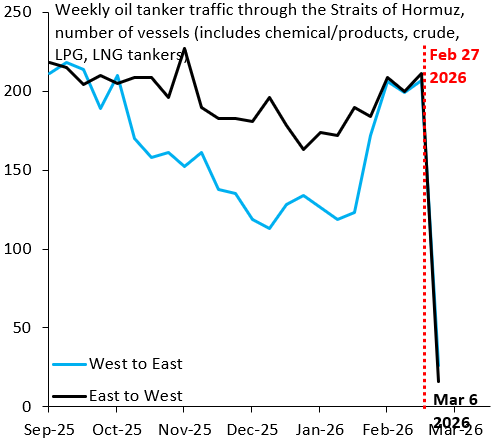
The war in the Persian Gulf appears to have reduced the traffic by around 29 per day, and there are no other routes out for this oil. A naive calculation suggests that would save between 1,250 and 125,000 future lives for each day the war continues. However, we know that production elsewhere will increase to take up the slack.
A better way to look at this is in terms of the oil price.
From https://www.hl.co.uk/shares/trading-commodities/brent-crude-oil March 11 2026 |
A quick glance at the oil price on Hargreaves Lansdown shows that over the course of the military buildup and the war prices have jumped by about 50%. A short term price increase of 50% leads to a 2.5% drop in world consumption. (A long term price increase of 50% would lead to a 20% drop in consumption.) Now, 20% of the world's oil and gas comes through the Straits of Hormuz, so this drop in consumption is 1/8th of the estimate we came up with by ignoring production increases elsewhere in the world.
So our final estimate is that there will be 160 to 16,000 fewer climate deaths for each day that the war continues. The two orders of magnitude difference between the lower and upper bounds are almost entirely down to our lack of certainty about the final death toll due to climate change. But nonetheless, even the lower end of that range is similar in scale to the number of deaths caused by the war itself, and the upper end massively surpasses that. It seems strange that even those who are very well informed about the climate crisis fail to take this into account. As for the mainstream media, all they appear to care about are prices at the pump.


Comments
Post a Comment